
When comparing braces vs clear aligners, the two most common ways to straighten your teeth, the right choice comes down to your bite, your lifestyle, and how noticeable you want treatment to be. Both traditional braces and clear aligners fix crowding, gaps, and bite issues — but they work differently, look different, and ask different things of you day to day.
Here’s a full breakdown of braces vs. aligners to help you decide before your next consultation.
How Braces and Aligners Work
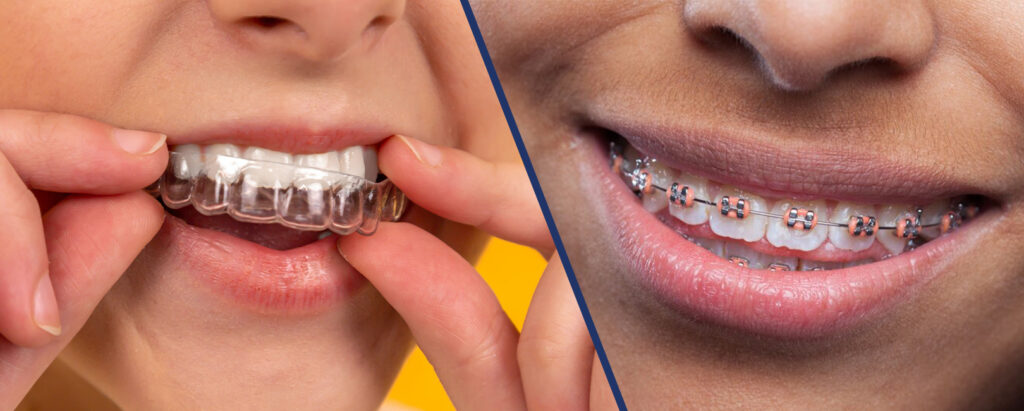
Traditional braces use small metal brackets bonded to each tooth. A thin wire runs through them, held in place by tiny ties. The wire applies steady pressure, and your provider adjusts it over time to guide your teeth into place.
Clear aligners use a series of custom plastic trays instead of brackets and wire. You wear each aligner for one to two weeks, then swap it for the next — gradually shifting your teeth along a pre-planned path.
Braces vs. Aligners at a Glance
| Traditional braces | Clear aligners | |
|---|---|---|
| Appearance | Braces are visible when you smile or talk because of the metal brackets and wires involved | Aligners are clear and much less noticeable |
| Removability | Braces stay on your teeth for the full length of treatment | Aligners come out for eating, brushing, and flossing |
| Wear time | Braces are attached via metal brackets for the duration of the treatment | Aligners only work if worn 20 to 22 hours a day. Skipping wear time slows progress in a way fixed braces don’t |
| Best for | Braces tend to handle more complex cases — significant crowding, large gaps, or jaw-related bite issues | Clear aligners work best for mild to moderate crowding or spacing |
| Food | Braces come with restrictions — sticky, hard, or crunchy foods can bend wires or break brackets | Aligners have no food restrictions at all, since you remove them before every meal |
| Cleaning | Braces need more careful brushing and flossing around brackets and wires. Many patients use a floss threader or water flosser | Aligners let you brush and floss normally, since the trays come out. The aligners themselves need regular cleaning to avoid staining or odor |
| Comfort | Braces and aligners can both cause some soreness as teeth shift. Braces can also irritate cheeks or lips where brackets rub, especially early in the treatment | Aligners can cause some soreness with each new tray, but otherwise cause less irration due to their smooth plastic material |
| Office visits | Every 4–6 weeks | Every 8–10 weeks |
| Treatment time | 12–24 months | 12–24 months |
| Typical cost | In Greater Boston, braces typically cost between $5,000–$8,000, but many dental insurance plans offer partial orthodontic coverage | In Greater Boston, clear aligners typically cost between $5,000–$8,000, but many dental insurance plans offer partial orthodontic coverage |
Costs and timelines vary by case and complexity. The only reliable way to know whether braces or aligners fit your case is an in-person evaluation. The American Association of Orthodontists recommends a first orthodontic evaluation by age 7, though active treatment itself often starts later.
How to Get Started in the Boston area
- Book a consultation — we’ll evaluate your teeth, bite, and goals in person or with imaging.
- Get your treatment plan — you’ll leave with a clear recommendation, timeline, and cost estimate.
- Begin treatment — we place your brackets or fit your first set of aligner trays.
Still have questions? Here’s what patients ask most before their first visit.
Frequently Asked Questions
Braces FAQ
A: Most patients come in every 4 to 6 weeks for an adjustment, where we tighten or replace the wire to keep guiding teeth into position. Some soreness for a day or two afterward is normal.
A: Contact your provider — a broken bracket or poking wire usually isn’t an emergency, but you should have it looked at soon so treatment stays on track. In the meantime, dental wax can help cover a wire that’s irritating your cheek.
A: Braces themselves don’t damage teeth, but poor brushing around brackets can lead to visible white spots or decay over time. Good oral hygiene throughout treatment prevents this.
A: There’s no age cutoff. A growing share of orthodontic patients today are adults, and braces work just as well later in life as they do for teens.
A: Teeth naturally drift back toward their original position without a retainer, sometimes within just a few months. Consistent wear, especially in the first year after braces or aligners come off, is what makes the results last.
Aligners FAQ
A: For mild to moderate cases, clinical results are generally comparable. For complex movement — significant crowding, large gaps, or jaw-related bite correction — most orthodontists still consider braces more reliable and precise.
A: Aligners are clear and fit closely to your teeth, so they’re far less noticeable than braces, though not fully invisible up close — most people won’t clock it unless they’re looking for it.
A: Contact your provider as soon as possible. Depending on where you are in treatment, your provider may tell you to move to the next tray early, go back to the previous one, or request a replacement.
A: Orthodontists call this “lagging,” and it happens occasionally. Your provider may recommend using chewies (small cylindrical aids) to help seat the trays fully, or adjust your treatment plan with refinement trays if needed.
A: Yes — the retention phase is the same regardless of which treatment you use. Without consistent retainer wear, teeth can shift back toward their original position.
Which Is Right for You
There’s no universal answer to the braces vs aligners question — it depends on your bite, how complex the correction is, and your lifestyle. For general guidance on orthodontic care, the American Dental Association is a good starting resource. Whichever option ends up being the better fit, the only way to know for sure is an in-person evaluation.
If you’re in the Boston area, our offices in East Boston, Revere, Quincy, Lynn, Brockton, and Salem offer both braces and clear aligners — book a free consultation, and we’ll walk you through what makes sense for your case.